QSFP Port Types: QSFP and MPO Explained
QSFP (Quad Small Form-factor Pluggable) ports accept hot-pluggable optical modules that transmit data over four parallel lanes, enabling 40 Gbps or 100 Gbps connections in a compact form factor. QSFP+ ports typically support 40G Ethernet, while QSFP28 ports support 100G Ethernet; both can break out into multiple lower-speed links using appropriate modules and cables. The port type determines which module families fit, but the module specification—wavelength, fiber type, reach and protocol support—determines whether the link will work.
What is a QSFP port?
A QSFP port is a high-density network interface designed to accept quad-lane pluggable optical or copper modules for 40G and 100G connections. The “quad” designation refers to the four parallel electrical lanes inside the module, each carrying a portion of the total data rate. This parallel architecture allows QSFP modules to achieve higher aggregate speeds in the same physical footprint as single-lane SFP, SFP+, SFP28 and QSFP port families explained.
QSFP ports are hot-pluggable, meaning modules can be inserted or removed without powering down the host equipment. The port provides power, data lanes and a management interface to the module. Network switches, routers and servers use QSFP ports for aggregation links, data center fabric connections, and high-speed server access.
QSFP+ vs QSFP28: understanding the families
QSFP+ and QSFP28 modules use the same physical port and connector, but differ in the speed of each internal lane. QSFP+ modules typically run 40G Ethernet by transmitting 10 Gbps per lane over four lanes (4 × 10G = 40G). QSFP28 modules run 100G Ethernet by transmitting 25 Gbps per lane over four lanes (4 × 25G = 100G). The “28” in QSFP28 refers to the nominal lane rate of 28 Gbps, which accommodates 25G Ethernet plus overhead.
Both module families share the same mechanical form factor defined by the QSFP Multi-Source Agreement (MSA), but QSFP28 requires higher-speed lane electronics and different optical or electrical specifications. Most switches have ports designated specifically for QSFP+ or QSFP28, and mixing module types in the wrong port may result in link failure or reduced performance.
Common QSFP module types and applications
QSFP+ 40G SR4 for short-reach multimode links
The 40G SR4 module uses four 850 nm VCSEL lasers over multimode fiber with MPO connectors. It reaches 100m on OM4 fiber and is commonly used for switch-to-switch connections within a data center or equipment room. The SR4 designation indicates “short reach” over four lanes, and the module requires 12-fiber MPO/MTP connectors to accommodate the four transmit and four receive fibers plus spares.
QSFP28 100G SR4 for data center fabric
The Aerless 100G QSFP28 SR4 (QSFP28-100G-SR4-IT) transmits 103.1 Gbps over four 850 nm VCSEL lanes, reaching 70m on OM3 or 100m on OM4 multimode fiber with MPO-12 connectors. The module operates from -40°C to +85°C, making it suitable for outdoor cabinets, remote cell sites and industrial environments where commercial-grade optics (0°C to +70°C) would fail. It conforms to IEEE 802.3ba and 802.3bm 100GBASE-SR4 standards, includes built-in clock and data recovery (CDR) on both transmitter and receiver, and supports digital diagnostics monitoring (DDM) for real-time link health reporting. Maximum power consumption is 2.5W from a single 3.3V supply.
QSFP28 100G LR4 for long-reach singlemode links
The 100G LR4 module uses four wavelengths (LAN-WDM: 1295.56 nm, 1300.05 nm, 1304.58 nm, 1309.14 nm) over a single duplex LC singlemode fiber pair, reaching 10 km. The four wavelengths are multiplexed onto one fiber in each direction, allowing the module to use standard duplex LC connectors instead of MPO. LR4 modules are used for campus backbone links, metro connections and any application requiring 100G over distances beyond multimode fiber reach.
QSFP28 100G PSM4 for parallel singlemode links
The 100G PSM4 module transmits over four parallel singlemode fibers with MPO connectors, reaching 500m to 2 km depending on specification. PSM4 uses a single wavelength (typically 1310 nm) on each of the four fiber pairs, rather than wavelength multiplexing. This approach offers a cost-effective alternative to LR4 for medium-reach singlemode applications where MPO cabling is acceptable.
Breakout: splitting QSFP ports into multiple links
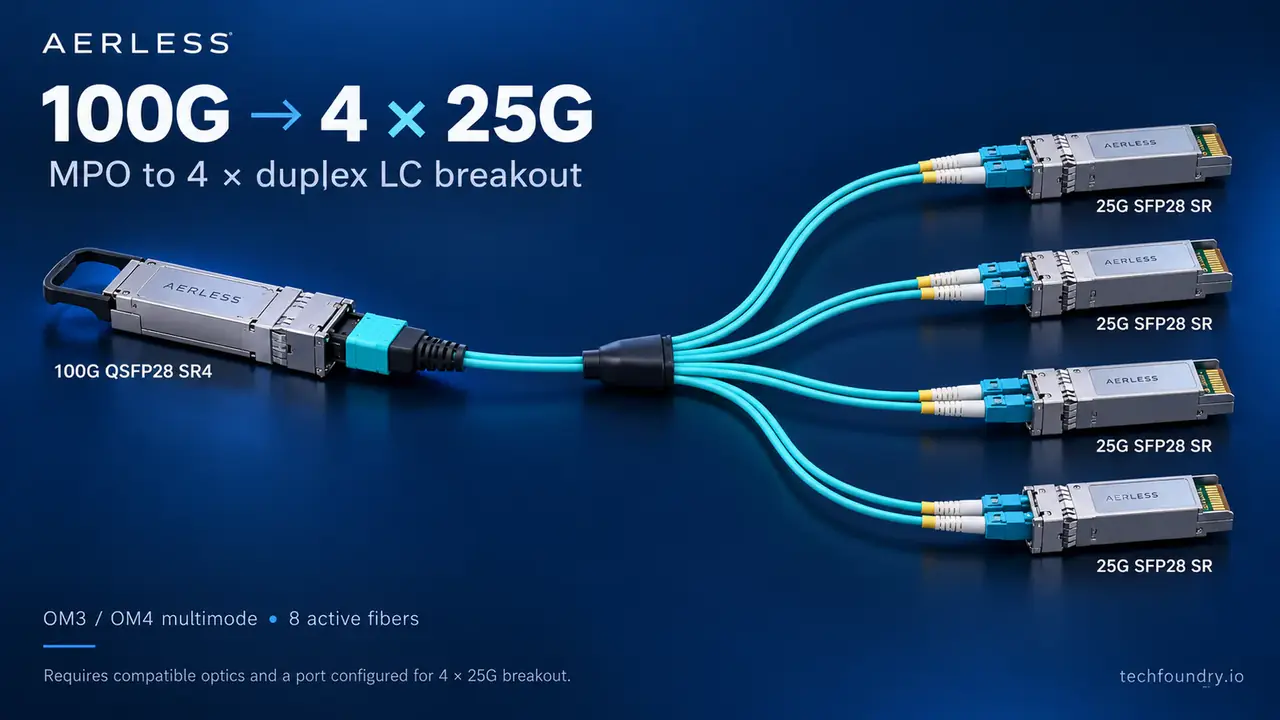
A QSFP28 port can break out into four independent 25G links using a breakout module or AOC cable; similarly, a QSFP+ port can split into four 10G links. Breakout mode is configured in the switch software to present four logical lower-speed interfaces instead of one high-speed interface. This flexibility allows a 100G port to connect to four separate 25G servers, or a 40G port to connect to four 10G devices, maximizing port utilization and reducing cost per connection.
The physical breakout is accomplished with either a breakout cable (QSFP on one end, four SFP28 or SFP+ modules on the other via an MPO-to-LC fanout) or a breakout AOC (QSFP on one end, four SFP28 or SFP+ connectors on the other, with integrated optics).
Fiber and cable requirements for QSFP modules
MPO connectors and polarity
QSFP SR4 modules use 12-fiber MPO connectors to accommodate four transmit lanes, four receive lanes, and four unused fibers. MPO polarity (Type A, B or C) defines how fibers are mapped from one connector to another. Polarity must match the cable and far-end module to ensure transmit lanes align with receive lanes; a polarity mismatch results in no link or intermittent errors. Most SR4 modules expect Type B polarity (key-up to key-down, straight-through fiber mapping), but always verify the module and cable specifications before deployment.
MPO to LC breakout cables
An MPO-to-4×LC breakout cable connects a QSFP28 SR4 module to four separate 25G SFP28 modules, enabling flexible aggregation or disaggregation. The Aerless MPO-4LC-OM4-2M cable has an MPO 12-fiber connector on one end and four duplex LC connectors on the other, with a total length of 2M and 0.5M branch legs. It uses OM4 multimode fiber (8 active cores) and supports 40G, 100G, 200G and 400G applications. Insertion loss is ≤0.75 dB standard or ≤0.35 dB for low-loss (Elite) grade at the MPO connector, and ≤0.3 dB at the LC connectors. The cable jacket is LSZH (low smoke zero halogen) and operates from -40°C to +70°C.
This cable is commonly used to connect a 100G QSFP28 SR4 module in a core switch to four Aerless 25G SFP28 modules in access switches or servers, or to connect a 40G QSFP+ SR4 module to four 10G SFP+ modules.
Active optical cables (AOC) integrate transceivers and fiber in a single assembly, eliminating separate modules and patch cords. An AOC has electrical connectors (QSFP28, SFP28, etc.) on each end and fiber in between, with the optics built into the connector housing. This simplifies deployment, reduces insertion loss (no intermediate connections), and can lower total cost for fixed-length links. Breakout AOC cables have a QSFP28 connector on one end and four SFP28 connectors on the other, providing a plug-and-play solution for 100G-to-4×25G breakout without separate modules or MPO cables.
Temperature ratings and environmental considerations
The Aerless 100G QSFP28 SR4 module (QSFP28-100G-SR4-IT) operates from -40°C to +85°C, suitable for outdoor cabinets, remote cell sites and industrial environments. Commercial-grade optics typically operate only from 0°C to +70°C and will fail, report errors or shut down in extreme cold or heat. Industrial-temperature modules use components rated for wider thermal ranges and include thermal management features to maintain performance across the full temperature span.
When specifying QSFP modules for outdoor or industrial applications, confirm both the module and cable temperature ratings. The Aerless MPO-4LC-OM4-2M cable operates from -40°C to +70°C, which may limit system performance in the coldest environments unless the cable is routed through temperature-controlled enclosures.
Switch compatibility and coding
QSFP modules are coded to match the buyer’s switch vendor, model and software version. Aerless confirms coding against the specific switch before order to ensure the module is recognized and link parameters negotiate correctly. Coding involves programming the module’s EEPROM with vendor-specific identifiers, supported speeds, power requirements and other parameters the switch firmware checks during module insertion.
When ordering, provide the switch manufacturer, model number, software version and port type. For telecom applications, also specify the protocol (100GBASE-SR4, CPRI, eCPRI, etc.) and any forward error correction (FEC) requirements. Aerless verifies compatibility before manufacturing and shipping the module, reducing the risk of field failures due to coding mismatches.
Choosing between QSFP+ 40G and QSFP28 100G
Select QSFP+ 40G when the switch port, installed fiber and application support 40G Ethernet or when breaking out to 4×10G links. QSFP+ is appropriate for aggregation in networks with 10G access layers, or for connecting 40G-capable servers and storage. If the switch has QSFP+ ports and the link budget supports 40G SR4 over the installed multimode fiber, QSFP+ modules are typically less expensive than QSFP28.
Choose QSFP28 100G for higher-density aggregation, data center fabric or when breaking out to 4×25G server connections. QSFP28 provides 2.5 times the bandwidth of QSFP+ in the same port density, reducing the number of ports and cables needed for a given aggregate capacity. If the network is migrating to 25G server access, QSFP28 with breakout to 4×25G offers a clear upgrade path. For more on choosing between multimode and singlemode fiber for 25G links, see the Aerless guide to 25G SFP28 eSR and LR modules.
Aerless QSFP modules: specifications and ordering
100G QSFP28 SR4 (QSFP28-100G-SR4-IT)
Form factor: QSFP28
Data rate: 103.1 Gbps aggregate (25.78 Gbps per lane)
Reach: 70m on OM3 multimode fiber, 100m on OM4 multimode fiber
Wavelength: 850 nm VCSEL array (four lasers)
Connector: MPO-12 (12-fiber MPO/MTP)
Temperature range: -40°C to +85°C (industrial)
Standards: IEEE 802.3ba 100GBASE-SR4, IEEE 802.3bm 100GBASE-SR4, SFF-8665 QSFP28 MSA, IEEE 802.3bm CAUI-4 Interface, SFF-8636
Transmit power: -8.4 to +2.4 dBm per lane
Receiver sensitivity: -10.3 dBm per lane
Features: Built-in CDR (clock and data recovery) on transmitter and receiver, DDM/DOM support for real-time diagnostics, hot-pluggable
Power consumption: 2.5W maximum, single 3.3V supply
Compliance: RoHS compliant, Class 1 Laser Product (21 CFR 1040.10 and 1040.11 except for conformance with IEC 60825-1 Ed. 3.)
Warranty: Two years
Lead time, pricing and warranty
Aerless modules are sourced and manufactured in Taiwan, supplied across the United States and Canada with 4 to 6 week lead time. Pricing is by quote with volume discounts available. All Aerless optical modules and cables are backed by a two-year warranty covering defects in materials and workmanship. For a quote on QSFP28 modules, MPO cables or breakout assemblies, contact the Aerless team with the application, environment, quantities and any known part numbers.
FAQ
What is the difference between QSFP+ and QSFP28?
QSFP+ modules typically support 40G Ethernet by transmitting 10 Gbps per lane over four lanes, while QSFP28 modules support 100G Ethernet by transmitting 25 Gbps per lane. Both use the same physical port form factor, but QSFP28 requires higher-speed lane electronics and is not backward-compatible with QSFP+ in most cases.
Can I break out a 100G QSFP28 port into four 25G links?
Yes, a 100G QSFP28 port can split into four independent 25G links using a breakout module, an MPO-to-4×LC breakout cable (such as Aerless MPO-4LC-OM4-2M) connecting to four SFP28 modules, or a 100G-to-4×25G breakout AOC. The switch must support breakout mode, configured in software to present four logical 25G interfaces instead of one 100G interface.
What fiber type do I need for a 100G QSFP28 SR4 module?
The Aerless 100G QSFP28 SR4 module (QSFP28-100G-SR4-IT) requires multimode OM3 fiber (reaching 70m) or OM4 fiber (reaching 100m), connected via 12-fiber MPO/MTP connectors. For longer distances, a 100G LR4 singlemode module is needed.
Do QSFP modules support digital diagnostics monitoring (DDM)?
Yes, the Aerless 100G QSFP28 SR4 module includes DDM (also called DOM, digital optical monitoring), reporting real-time transmit power, receive power, temperature, voltage and other parameters over the management interface. This enables proactive monitoring and troubleshooting of optical link health.
Are Aerless QSFP modules rated for outdoor use?
Yes, the Aerless 100G QSFP28 SR4 module operates from -40°C to +85°C, meeting industrial temperature requirements for outdoor cabinets, cell sites and other harsh environments. Commercial-grade modules typically operate only from 0°C to +70°C and will fail or report errors in extreme cold or heat.
What is the warranty on Aerless QSFP modules and cables?
Aerless provides a two-year warranty on all optical modules and cables, including QSFP28 transceivers and MPO patch cords and breakout cables.
Plan the infrastructure
Working through a network requirement?
Send the application, environment, quantities and any known part numbers. The Aerless team will help translate them into a practical equipment quote.

Join the conversation
Comments are reviewed before they appear. Your email address will not be published.