OSFP Ports Explained: 400G and 800G Optical Modules

OSFP (Octal Small Form Factor Pluggable) is a pluggable optical module format designed for 400 Gbps and 800 Gbps data center applications. It uses eight electrical lanes and offers higher power and thermal capacity than QSFP-DD, making it suitable for longer-reach optics and next-generation switch fabrics. OSFP ports appear in hyperscale data centers and high-performance computing environments where link density, reach and future bandwidth growth matter.
What OSFP means and where it fits
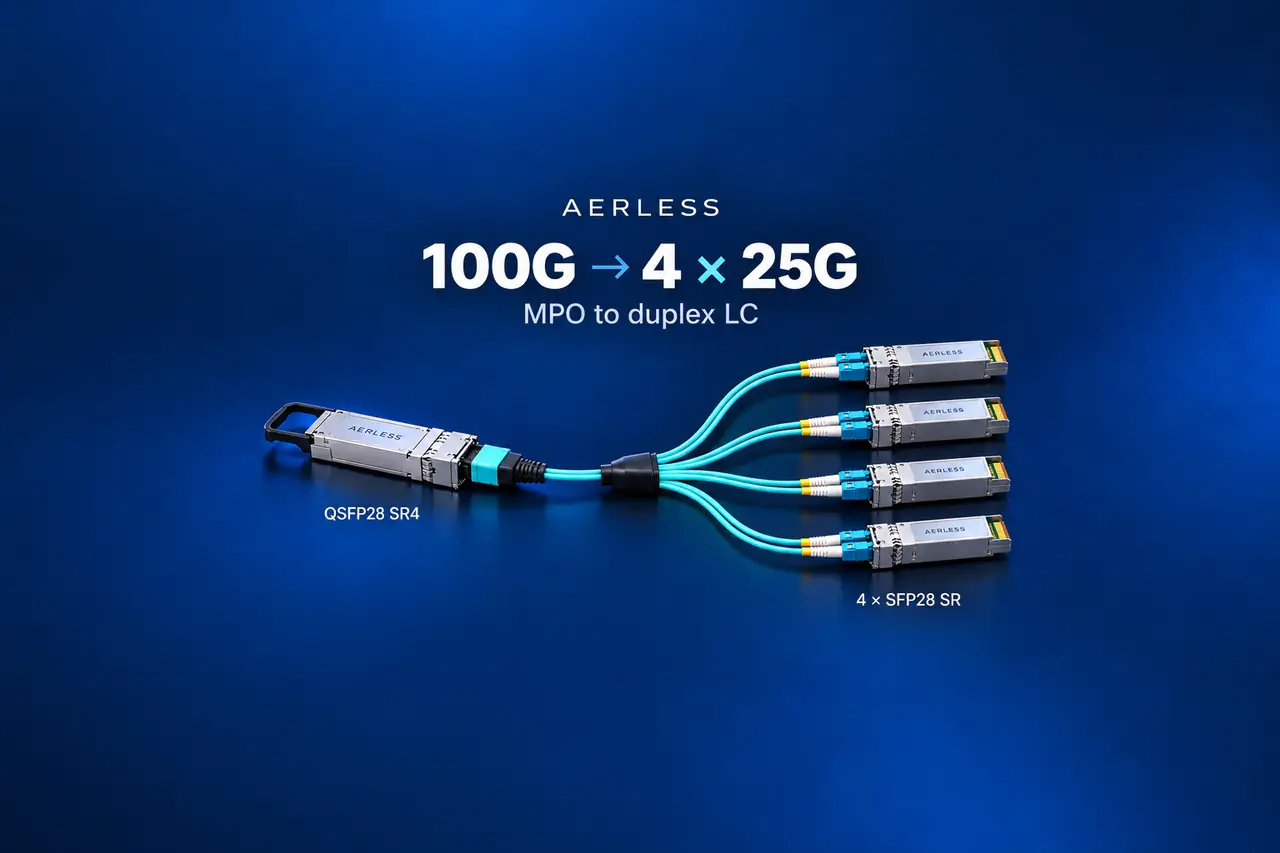
OSFP is an eight-lane pluggable module standard developed for 400G and 800G Ethernet. The format was introduced to address the thermal and power limitations of earlier module families as data rates climbed beyond 100G per lane. Where a QSFP28-100G-SR4-IT module uses four 25G lanes to deliver 100 Gbps, OSFP modules use eight 50G or 100G lanes to reach 400G or 800G.
The larger physical size and improved thermal design allow OSFP modules to dissipate more heat than QSFP-DD, which makes them practical for longer-reach optics that require more power for amplification and signal processing. OSFP ports are found in spine switches, core routers and AI cluster interconnects where aggregate bandwidth, reach and future scalability justify the larger port footprint.
OSFP vs QSFP-DD: physical and electrical differences
OSFP modules measure 22.58 mm wide, compared with 18.35 mm for QSFP-DD. The extra width provides more surface area for heat dissipation and allows a higher power budget,. Both formats use eight electrical lanes, but OSFP uses a different mechanical latch and connector pinout, so the two are not interchangeable.
The OSFP specification also defines a removable heat sink that can be swapped without removing the module from the cage. This feature is useful in high-density switches where airflow is constrained and thermal management becomes a design constraint. QSFP-DD modules use a fixed heat sink or rely on the cage and faceplate for cooling.
Both formats support 400G and 800G Ethernet, so the choice between them depends on the switch platform, the required reach and the thermal environment. Many 400G switches use QSFP-DD ports because the smaller size allows higher port density on a fixed-width faceplate. OSFP is more common in platforms where reach, power budget or future 800G support takes priority over port count.
Common OSFP applications
OSFP modules are deployed in 400G and 800G switch uplinks, spine-leaf data center fabrics and AI/ML cluster interconnects where reach, power and thermal performance justify the larger port footprint. The format is also used in telecom transport equipment and high-performance computing networks where aggregate bandwidth and low latency matter.
In a typical data center spine-leaf architecture, OSFP modules connect leaf switches to spine switches over single-mode fiber, using DR4 or FR4 optics for 500 m to 2 km links. In AI training clusters, OSFP modules connect GPU servers to the switching fabric, often using short-reach SR8 optics over multimode fiber or active optical cables.
The higher power budget of OSFP also makes it practical for coherent optics and longer-reach modules that would exceed the thermal limits of QSFP-DD. As 800G deployments grow, OSFP is expected to become more common in core and aggregation layers where bandwidth density and reach both matter.
OSFP module types and reach
400G OSFP modules include SR8 for multimode links up to 100 m, DR4 for single-mode links up to 500 m, and FR4 or LR4 for 2 km and 10 km. SR8 modules use eight parallel fibers in an MPO connector and are designed for short links within a data center row or between adjacent racks. DR4 modules use four wavelengths over a single duplex fiber pair, which simplifies cabling and reduces fiber count in structured installations.
800G OSFP modules use SR8, DR8 and other variants for similar reach categories at doubled lane rates. The electrical lanes run at 100G PAM4 instead of 50G, which increases the power draw and thermal load but keeps the same physical connector and fiber infrastructure. Some 800G modules also support 2 x 400G breakout, allowing a single OSFP port to connect to two 400G endpoints.
The choice between module types depends on the installed fiber, the required reach and the switch port configuration. For guidance on fiber selection in lower-speed modules, see 25G SFP28 eSR vs LR: Fiber Selection Guide.
When to choose OSFP over QSFP-DD
Specify OSFP when the switch or router uses OSFP ports, when you need the additional power budget for longer-reach optics, or when the roadmap calls for 800G and the platform supports it. If the switch datasheet lists OSFP cages, you must use OSFP modules; QSFP-DD modules will not fit.
If the platform supports both formats, compare the available module types, reach specifications and port density. QSFP-DD offers higher port count per rack unit, which matters in leaf switches where every port connects to a server or storage device. OSFP offers higher power budget and better thermal performance, which matters in spine switches where longer reach and future 800G support justify the larger size.
Check the switch software release notes for module compatibility and any required configuration steps. Some platforms require specific firmware versions or port settings to enable OSFP modules, and not all modules are qualified on every switch model. For a broader introduction to module families and port types, start with Understanding SFP Ports and Their Types.
Aerless optical modules: current portfolio and roadmap
Aerless supplies 1G, 10G, 25G, 40G and 100G optical modules today, with 400G and 800G modules on the product roadmap. Current modules include the SFP28-25G-LR-IT for 25G single-mode links up to 10 km and the QSFP28-100G-SR4-IT for 100G multimode links up to 100 m on OM4 fiber. Both are rated for industrial temperature (−40°C to +85°C) and are manufactured in Taiwan.
All Aerless modules are coded for the buyer’s switch before shipment. Coding is confirmed against the switch model and software version to ensure compatibility. Lead time is 4 to 6 weeks, and all modules carry a two-year warranty. For immediate 400G or 800G requirements, contact the Aerless team to discuss options and lead times.
FAQ
Are OSFP and QSFP-DD modules interchangeable?
No. OSFP and QSFP-DD modules have different physical dimensions, mechanical latches and port pinouts, so an OSFP module will not fit a QSFP-DD port. Both use eight electrical lanes, but the host equipment determines which form factor you need. Check the switch datasheet or port label to confirm which module type the port accepts.
What speeds do OSFP modules support?
OSFP modules are designed for 400 Gbps (eight lanes at 50G PAM4) and 800 Gbps (eight lanes at 100G PAM4). Some OSFP ports can also operate at lower speeds when configured with compatible modules and switch software, but this is less common than running the port at its native rate.
Do I need OSFP for a 400G link?
Not necessarily. Many 400G switches use QSFP-DD ports instead of OSFP, and QSFP-DD modules are available for the same reach categories. The module format is determined by the switch port, not the link speed. Check your switch datasheet to see which module type the port accepts, then choose the module variant (SR8, DR4, FR4, LR4) based on fiber type and required reach.
Does Aerless supply OSFP modules?
Aerless currently supplies 1G, 10G, 25G, 40G and 100G optical modules, with 400G and 800G modules on the product roadmap. For immediate 400G or 800G requirements, contact the Aerless team to discuss options and lead times. Current modules include the SFP28-25G-LR-IT and QSFP28-100G-SR4-IT, both rated for industrial temperature.
What fiber types do OSFP modules use?
Short-reach OSFP modules (SR8) use OM3 or OM4 multimode fiber with MPO connectors. Medium- and long-reach modules (DR4, DR8, FR4, LR4) use single-mode fiber, typically with duplex LC or MPO connectors depending on the module variant. The fiber type and connector are determined by the module specification, not the OSFP format itself.
How much power does an OSFP module draw?
OSFP modules can dissipate up to 12 to 15 W, depending on the module type and reach. This higher power budget compared with QSFP-DD allows longer-reach optics and higher-performance DSP, but it also increases switch cooling requirements. Check the switch power budget and thermal specifications to confirm that the chassis can support the number of OSFP modules you plan to install.
Plan the infrastructure
Working through a network requirement?
Send the application, environment, quantities and any known part numbers. The Aerless team will help translate them into a practical equipment quote.


Join the conversation
Comments are reviewed before they appear. Your email address will not be published.