Agentic systems with clear boundaries
When a good answer still leaves someone to do the work.
An agent that acts, inside limits you set.
Build agents that can interpret requests, retrieve relevant information and use connected tools. Keep permissions, review steps and exception handling visible to the people responsible for the work.
Discuss your project ↗AI Agents
- 01Read the request
- 02Check context and tools
- 03Act or request review
The starting point
A model that answers is not a system that acts.
A conversational interface is only one part of an agentic system. The surrounding workflow determines what the agent can access, which actions it may take and when someone needs to review its work.
Document and request intake
Interpret incoming documents, extract required fields and flag missing or ambiguous information before it moves downstream.
Knowledge assisted workflows
Retrieve information from approved sources, preserve references and help staff make informed decisions within their access permissions.
Tool using agents
Connect selected business tools through controlled interfaces. Define which actions can proceed automatically and which require approval.
Evaluation and oversight
Build representative scenarios, review failures and define escalation paths. Track useful outcomes rather than relying on a polished demo alone.
Before you get in touch
Is this the right
piece of work?
We would rather tell you it is not than take a project that was never going to land well.
This fits when
- The same decision is made many times a day, against information that already exists somewhere.
- You can say what the agent must never do on its own.
- Someone will own the exceptions when it escalates.
Probably not when
- The task needs judgement nobody has written down and nobody can describe out loud.
- What is actually wanted is a chatbot on the website rather than work getting finished.
What we need from you
- Access to the systems and documents the agent has to read.
- A person who can decide what needs review and what does not.
- Patience with a first version that escalates more than it eventually will.
What that looked like
Inventory Management System
Two agents in production. One reads incoming purchase orders, validates them, matches every line against SAP equipment and either allocates stock or raises supplier orders. The other watches the numbers and routes anomalies to whoever can act on them. Anything ambiguous goes to a conflict queue instead of being guessed.
Read the case study ↗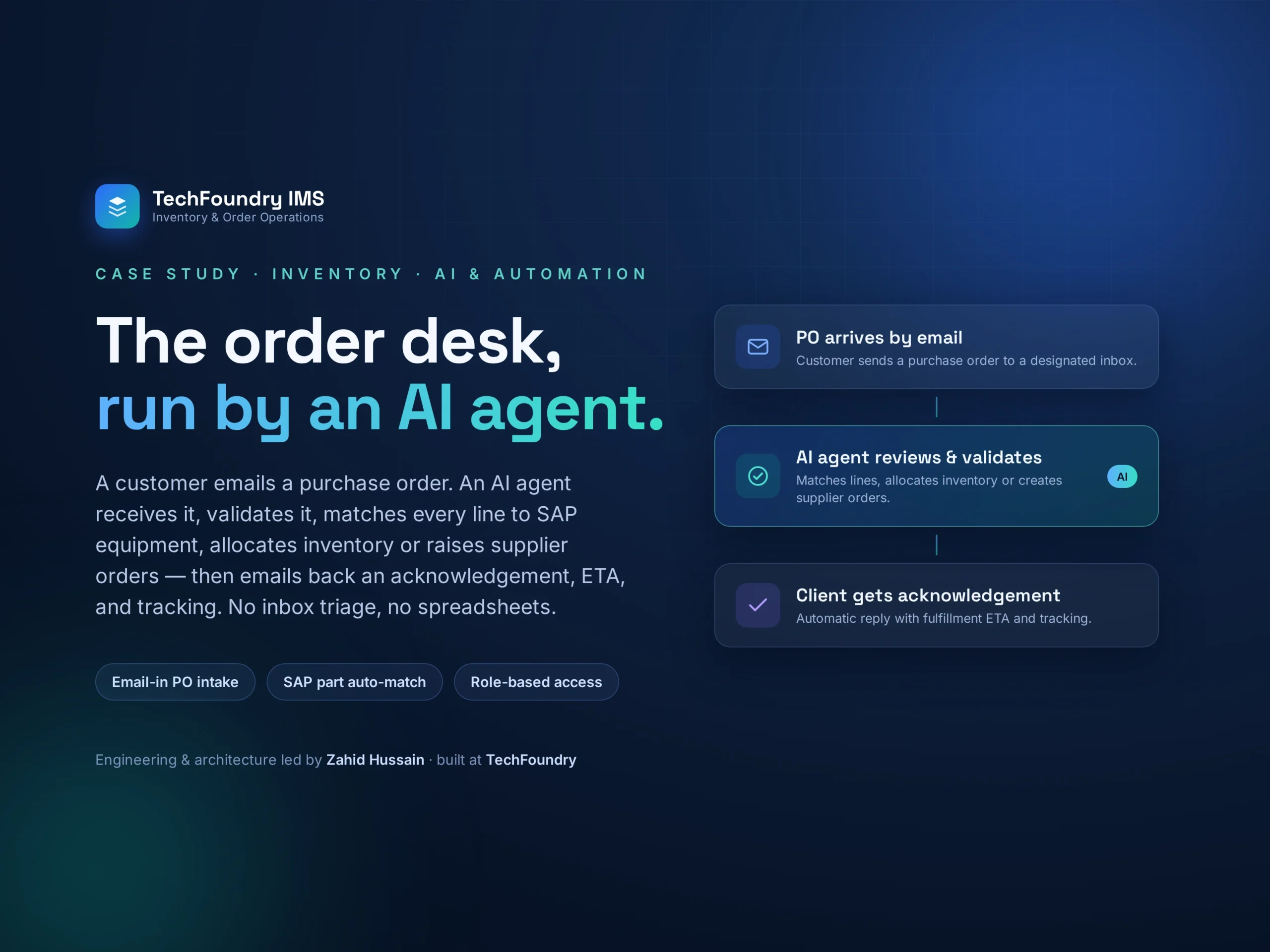
A workflow to picture
For order intake, an agent can extract order lines, check a product mapping and route an uncertain match to a person before the order proceeds.
See a related example ↗Before we begin
Useful questions.
Clear answers.
Will the agent make decisions on its own?
Only within the boundaries agreed for the use case. Actions with business consequences can require a person to review and approve them.
Can the agent use our internal knowledge?
Where access is authorized, we can design retrieval around your documents and records. Source quality, permissions and data handling are part of discovery.
Is the website demonstration a live AI agent?
The public showcase is a scripted interactive demonstration using sample data. It illustrates the workflow without connecting to your systems or running a model.
How to engage with us
Good work starts
with a conversation.
Tell us what you want to build or improve, and we will come back with a practical next step rather than a sales sequence.
Teams we have worked with
Read client feedback ↗