Open source framework · Dendra
Dendra. An open source framework for APIs and AI tools.
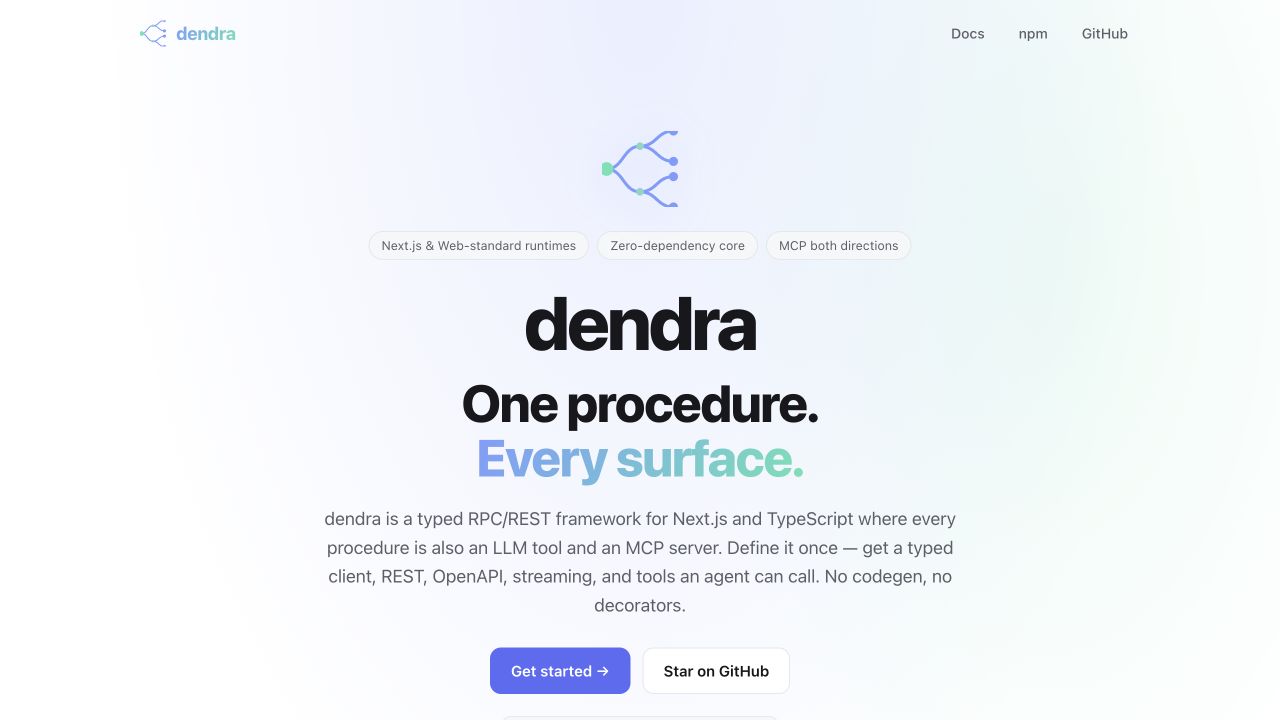
Dendra is TechFoundry’s open source TypeScript framework for building typed APIs, REST endpoints and MCP tools from shared procedure definitions.
 TypeScript
 Next.js
 Node.jsMCPOpenAPI
What changed
- One definition for application APIs and AI tools
- Shared validation and middleware
- An open source core with optional integrations
The challenge
An application may need the same operation in several places: a typed web client, a REST API, an integration document and an AI assistant. Defining each interface separately creates extra work whenever an input, permission check or business rule changes.
Dendra approaches that problem at the procedure level. It is TechFoundry’s open source TypeScript framework for connecting application APIs and AI tools through a shared definition. This case study examines the product architecture and its implemented capabilities.
The product we built
A developer defines a procedure with an input schema and a handler, then adds middleware, an HTTP route or AI tool metadata where needed. Adapters expose that definition to the interfaces the application uses.
The result is one place to maintain the operation’s contract. A typed client can infer its inputs from the router. REST handlers and OpenAPI documentation use the procedure metadata. Procedures explicitly marked for AI use can also become model tools and Model Context Protocol tools.
One contract across several interfaces
Dendra separates the operation from the way it is called. The same router can support a typed client, HTTP adapters, REST routes, an OpenAPI 3.1 document and direct calls inside the server. Streaming procedures provide another way to return work as it progresses.
- Application developers get client types inferred from the router, without a separate client code generation step.
- Integration teams can use REST routes and an OpenAPI document derived from the procedure definitions.
- Agent developers can expose selected procedures as tools, using the existing input contract and execution path.
These are supported interfaces, not automatic deployment services. The application still chooses which adapters to mount and which operations to expose.
AI access is an explicit choice
Dendra requires a procedure to opt into AI exposure with .ai(). Unmarked procedures are excluded from the generated toolset, and the tool executor rejects attempts to call them. Input validation runs before the handler, including when a model supplies the arguments.
Middleware can reject a request or extend its context before business logic runs. That lets an application apply its authentication and permission checks through the same procedure path used by ordinary API calls and AI tools. The application must supply those checks and the correct user context; the framework does not invent an authorization policy.
Dendra also provides primitives for consuming tools from external MCP servers and combining them with local tools. Connection setup, transport and credentials remain application responsibilities.
A focused core with clear boundaries
The core package has no required runtime dependencies. Optional helpers, including the Anthropic agent loop and React assistant hook, use their own peer dependencies. Teams can adopt the procedure and tool primitives without adopting a complete chat interface or changing their database.
The repository includes a Next.js notes application that demonstrates how these pieces fit together. It is a reference application, not evidence of customer adoption or a production performance benchmark.
Authentication, tenant permissions, storage, user interfaces and external connection management belong to the application. Keeping that boundary clear makes the framework’s role easier to understand and evaluate.
What the implementation delivers
- A shared procedure definition for application calls and explicitly exposed AI tools.
- Input validation and middleware reused through the central execution path.
- Typed clients, REST and OpenAPI support, streaming and MCP integration primitives.
- Public source, documentation and an example application that developers can inspect.
The source includes tests for tool exposure, invalid arguments and middleware rejection. These support specific implementation behaviors; they are not a security certification. No customer revenue, time savings or performance improvement is claimed in this case study.
This review is based on the 0.7.0 source snapshot checked on 17 October 2026. Dendra is a pre 1.0 project released under the MIT license. Teams evaluating it should review current releases, test their own access controls and validate the fit for their workload.
Explore the product
Visit Dendra to see the framework, or start with the quickstart and architecture guide. The public source repository contains the implementation and example application.
Building an application that needs both conventional APIs and controlled agent access? Tell TechFoundry what the system needs to do.
How to engage with us
Good work starts
with a conversation.
Tell us what you want to build or improve, and we will come back with a practical next step rather than a sales sequence.
Teams we have worked with
Read client feedback ↗